Exploring the past to inform the future
“Those who cannot remember the past are condemned to repeat it.” ~ George Santayana
“The thing that hath been, it is that which shall be; and that which is done is that which shall be done: and there is no new thing under the sun.” ~ Ecclesiastes 1:9-10 (KJV)
The study of history allows one to more competently enter into the future with eyes wide open. While we may not be able to find the exact same situation which we are currently experiencing, chances are that if we study enough, we can find an occurrence that is similar enough to our current one that it can lend us a hand in dealing with the matter.
“There is a partly justified criticism that peacetime generals are always fighting the last war instead of the next one.” ~ Dallas Morning News
Gray Rinehardt was writing about theory, but what he wrote pertains as much to history as it does to that topic: “[The study of history] allows us to categorize facts and experience in such a way that we may make sense of them for future use. From the conditions we face and the experiences we recall, we formulate ideas about what may happen; then we evaluate our subsequent experiences and learn whether our ideas were correct.”* It is my hope that my writings will help readers remember the past in preparation for the future.
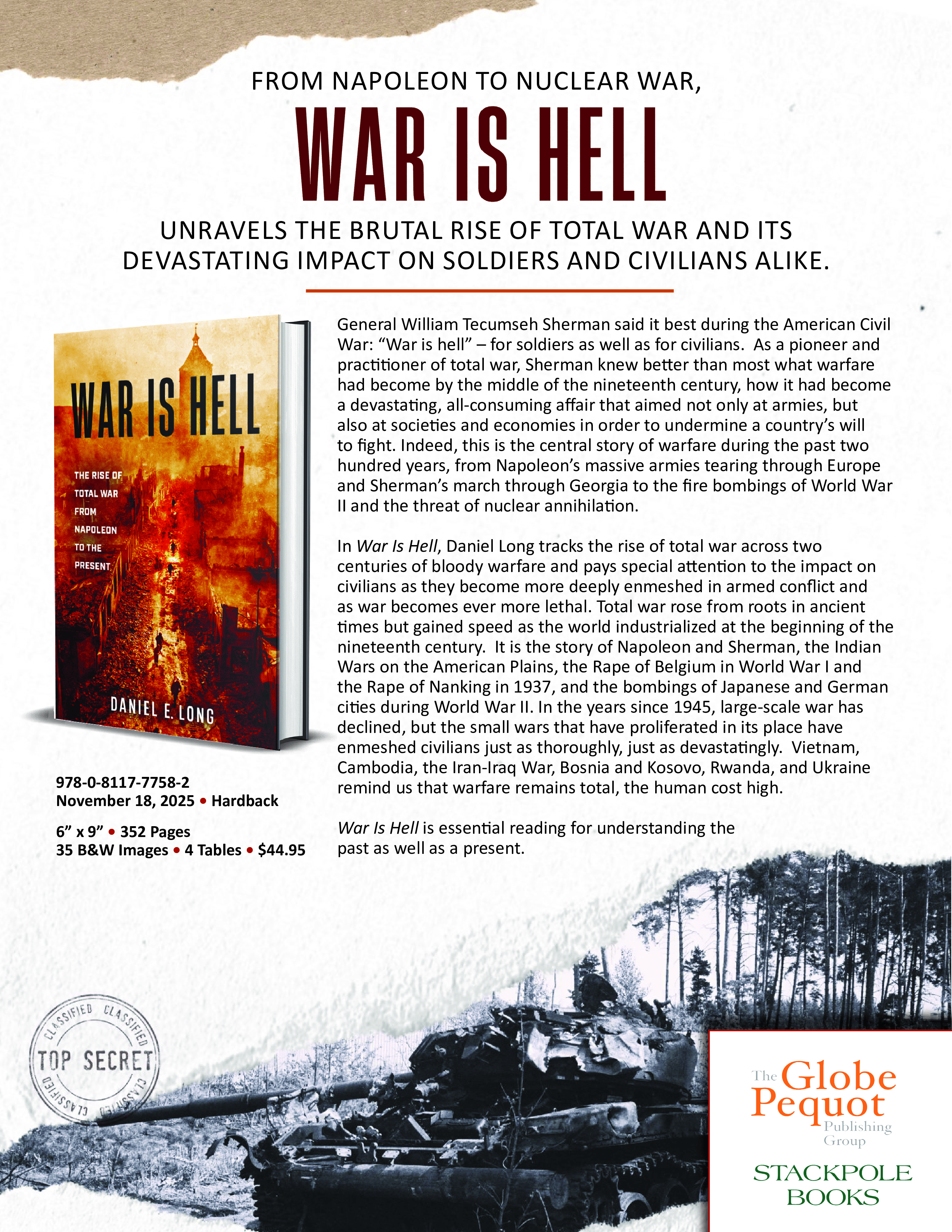
WAR IS HELL: THE RISE OF TOTAL WAR FROM NAPOLEON TO THE PRESENT
From Napoleon to nuclear war, War Is Hell unravels the brutal rise of total war and its devastating impact on soldiers and civilians alike.
Table of contents
Get a look at some of the content covered in the book. Everything you need to know is inside.
CHAPTER 1: ANTIQUITY TO 1860
CHAPTER 2: CIVIL WAR, 1860-1914
CHAPTER 3: WORLD WAR I, 1914–1918
CHAPTER 4: INTERWAR PERIOD, 1919-1937
CHAPTER 5: WORLD WAR II, 1937-1945
CHAPTER 6: POST-WORLD WAR II: 1945-TODAY
*Rinehart, Gray. 2019. Elements of War: Theory of Knowledge, and War. Cary, NC: Stormwatch, 22. https://www.amazon.com/Elements-War-Theory-Knowledge/dp/0998209236.
Designed with WordPress
© 2025, Daniel E. Long, DDS, MA. All rights reserved.
 Daniel E. Long